


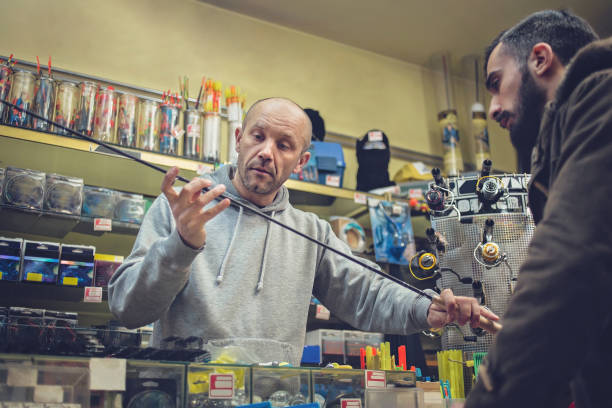
We’ve all heard it, or maybe even said it ourselves. You pick up a fishing rod in a shop, give it a gentle flex, and nod sagely. “Nice feel,” you mutter. Another angler hands you their prized stick on the water. You make a few casts, fight an imaginary fish, and hand it back. “Wow, that has a great feel,” you say, maybe feeling a tinge of gear envy.
But what are we actually talking about? “Feel” is that fuzzy, all-encompassing term we use for everything we can’t easily quantify. It’s not just the weight. It’s not just the bend. It’s… the sensation. The connection. And for decades, it was pure black magic, dictated by obscure rod-building lore. Turns out, there’s a ton of fascinating engineering and materials science behind that magical sensation. Today, let’s demystify it. Let’s talk about why some rods feel like a natural extension of your arm, and others feel like you’re waving a pool noodle at the fish.
Beyond the Bend: It’s a System, Not a Stick
First, we need to shift our thinking. A modern fishing rod isn’t just a tapered piece of fiberglass or carbon. It’s a highly tuned system designed to manage energy. From the moment you start your cast to the split-second you set the hook, the rod is absorbing, storing, transferring, and releasing energy. How efficiently and predictably it does this dictates the “feel.” A clunky system loses energy as friction and vibration (bad feel). A refined system channels it with purpose (good feel).
This system has three main players: the blank, the guides, and the handle. Screw up one, and the whole experience falls apart.
The Heart of the Matter: Blank Technology & “Soul”
The blank is the soul of the fishing rod. Its material and construction define its fundamental character. Gone are the days of one-material-fits-all.
- Graphite/Carbon Fiber: The Neurotic Genius. This is the standard for performance. High-modulus carbon fiber is incredibly stiff for its weight, which allows for thinner, more sensitive blanks. Here’s the cool part: the “modulus” (a measure of stiffness) isn’t the only story. The way the carbon fibers are woven, layered (in what’s called a “roll-wrapped” or “spiral” pattern), and bonded with resin creates specific dampening properties. A well-made carbon blank doesn’t just transmit vibration—it transmits useful vibration. It tells you “tap-tap” is a bluegill nibble and “THUMP” is a bass inhaling your craw. Our 2-Section Carbon Fiber Spinning Rod is a masterclass here. That 101 g weight isn’t just a bragging point; it’s the result of advanced carbon layup that provides “outstanding amplitude and vibration transmission.” In human terms? You feel everything, without your arm falling asleep.
- Fiberglass: The Forgiving Veteran. More flexible and slower to recover than graphite, fiberglass has a different kind of feel—often described as “soft” or “parabolic.” It absorbs shock incredibly well, which is why it’s still beloved for techniques like treble-hook crankbait fishing, where it keeps fish pinned. It’s less about telegraphing subtle ticks and more about smooth, powerful bending.
- Composites: The Best of Both Worlds? Many modern fishing rods blend materials, using carbon for sensitivity in the tip and fiberglass or other materials in the midsection for power and forgiveness. The goal is to create a specific “action” and “power.”
Action & Power: The Vocabulary of Feel

These terms get thrown around a lot, but they’re crucial for understanding what a rod is designed to do.
- Action (Fast, Moderate, Slow): This describes where the blank bends. A fast-action rod bends mostly in the top third. It feels crisp and responsive and is excellent for quick hook sets and single-hook techniques like jigging or worm fishing. A slow-action rod bends deeply into the butt, feeling more fluid and gentle—perfect for protecting light tippets on a fly rod or fighting fish on light line.
- Power (Ultra-Light to Heavy): This is the rod’s backbone, its resistance to bending. It’s the difference between a rod designed for 2-pound test and 50-pound test. Power and action work together. You can have a fast-action, light-power rod like a finesse bass stick or a fast-action, heavy-power rod like a flipping stick for punching through mats.
The magic happens when action and power are perfectly matched to the rod’s intended use. A fast-action, medium-power fishing rod is often considered one of the best all-around types for bass because it offers a great mix of sensitivity and hook-setting power.
The Unsung Heroes: Guides, Reel Seats, and Handles
A masterpiece blank can be ruined by cheap components. This is where many budget fishing rods fail the “feel” test.
- Guides: The Energy Highway. Their job is to reduce friction and keep line flow smooth. Micro-vibrations from a lumpy retrieve or a bumpy guide ring get transmitted right back to your hand, muddying the signal. High-quality guides, such as alumina or ceramic rings, have a smooth, hard surface that creates a silky-smooth path for the line. Ever notice how a high-end rod just sounds smoother when you cast? That’s the guides. They’re a huge part of that refined feel.
- Reel Seat & Handle: The Connection Point. This is your physical interface with the system. An unbalanced fishing rod, where the reel feels like it’s tipping forward or backward, creates fatigue and kills feel. A good reel seat locks the reel in solidly; no wiggles. The handle material matters more than you think. EVA foam is light and comfortable, while natural cork has a classic, warm grip that many anglers prefer for its slightly better “grip” when wet. It’s about personal comfort and secure connection.
Putting It All Together: The “Sweet Spot” Rod
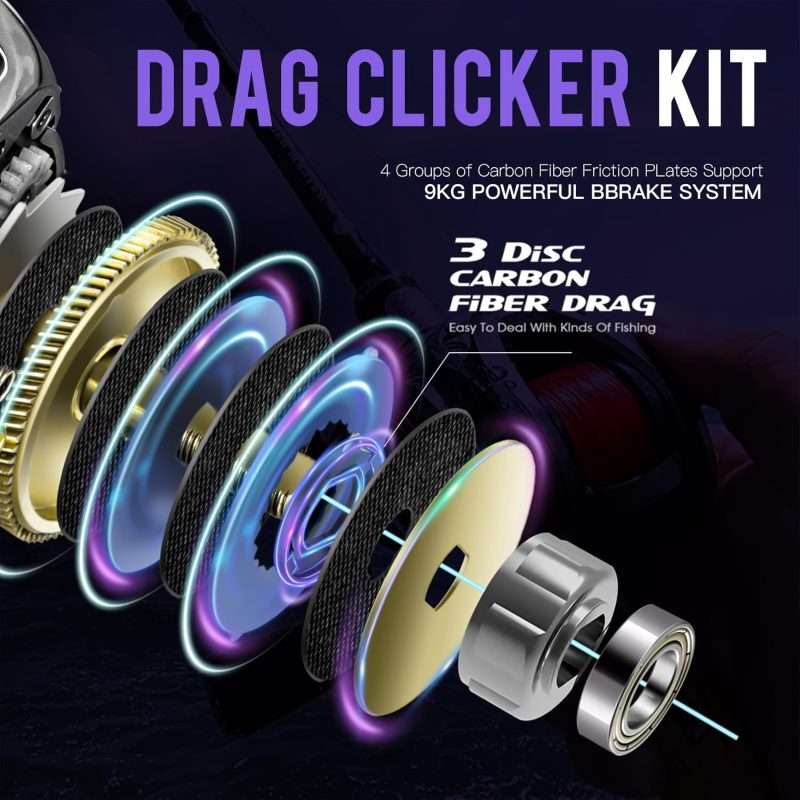
So, what does a harmoniously tuned system feel like in practice? Let’s take a specific example: the baitcasting fishing reel paired with an appropriate rod.
That reel boasts an 8.1:1 high-speed retrieve and a carbon drag system. For it to feel right, it needs a fishing rod that can keep up. You’d pair it with a fast or extra-fast action rod with a stout enough backbone to handle the 20 lb. drag. When a fish runs, the reel’s smooth drag provides constant pressure, while the rod blank acts as a shock absorber, loading and unloading smoothly. The sensitive tip lets you feel the lure working, and the fast action translates your hook-set motion instantly to the point. The guides ensure the braided line flows without snagging. That’s how it feels. It’s the seamless conversation between you, the gear, and the fish.
Finding Your Feel
Here’s the personal bit: “Feel” is subjective. A tournament bass angler’s ideal “feel” might be utterly wrong for a steelhead drifter who needs a slower, more forgiving bend. My advice? Know the technique you love.
Are you chasing subtle trout in clear streams? Prioritize ultra-light sensitivity. Are you heaving big lures into the saltwater surf for stripers? You need a rod with a powerful blank that can load up for distance but still has a sensitive tip to detect bites. Our High Carbon Fiber Sea Pole is built for this versatility, with its reinforced construction designed to detect anything from panfish to stripers in tough environments.
Don’t just look at specs. If you can, get the rod in your hands. Flex it. Imagine the cast. Better yet, see if you can test a friend’s setup. The “best” fishing rod isn’t the one with the most impressive jargon on the box. It’s the one that disappears in your hands, making the connection between you and the water feel instinctive, immediate, and absolutely electric. That’s not magic. That’s brilliant engineering.
Experience the difference for yourself—browse our technologically advanced fishing rods today.