


Let’s be honest. When we get home from a long, muddy, or salt-encrusted day on the water, what’s the ritual? We lovingly rinse off our prized fishing rod, maybe even give it a gentle wipe down before leaning it carefully in its spot in the garage. The fishing reel? Eh, maybe we give it a shake to get the big chunks off. It’s just a hunk of metal and plastic, right? It’ll be fine.
Until it isn’t.
That’s when the dreaded sounds start. The faint, gritty crunch on the retrieve that wasn’t there before. The hesitant, stuttering drag when a fish makes a run. The once-silent operation now whines with a new, annoying pitch. We curse the manufacturer, vow to buy a new one, and blame it on “just wearing out.”
But here’s the uncomfortable truth we often ignore: fishing reels don’t just “wear out” from normal use. They are murdered by neglect. That fishing reel is a precise mechanical instrument, full of tiny gears, bearings, and calibrated friction surfaces. It’s the workhorse of your combo, and it’s begging for a fraction of the care you give its flashier partner, the rod. Today, we’re going to break the cycle. Let’s talk about the simple, non-scary maintenance that will keep your fishing reel—and your fishing wallet—happy for years.
The Anatomy of Grime: Where the Enemy Hides

To care for something, you need to know what you’re up against. For a fishing reel, the enemies are a sinister trio: saltwater, sand, and old grease.
- Saltwater is Public Enemy #1. It’s not just surface rust; it’s a corrosive that seeks out tiny gaps, invades bearings, and seizes up moving parts from the inside out. It turns smooth aluminum into pitted, crusty ruins.
- Sand and grit are the silent abrasives. A single grain of sand inside a gear system or a bearing race acts like a miniature grinding stone, wearing down precision-machined surfaces at an alarming rate. That “gritty” feeling is literal.
- Old, broken-down grease and oil might be the most surprising villain. Lubricants don’t last forever. They break down, get contaminated with water and dirt, and turn from a slick protector into a sticky, grime-trapping sludge. This gunked-up lube increases friction, overheats components, and accelerates wear.
These enemies don’t attack all at once. They work slowly, in the shadows, after you’ve put the gear away. A day in the surf without a rinse. A dusty trail ride on an ATV. A season of use without a thought. This is death by a thousand cuts.
The Five-Minute Miracle: Post-Trip Care That Actually Works
You don’t need to be a watchmaker. Effective maintenance is about consistent, simple habits, not annual overhauls. This five-minute routine after every trip, especially a saltwater one, will add years of life.
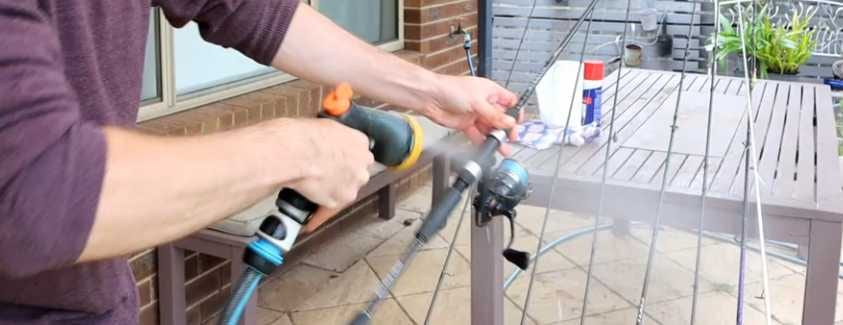
- The Gentle Rinse: With the fishing reel still on the rod, use a gentle stream of fresh, lukewarm water. Never use a high-pressure hose, which can force water and dirt past seals. Rotate the handle to let water flow through the line roller. The goal is to dissolve and flush away salt and loose debris.
- The Drip Dry: Shake off the excess water. Then, leave the fishing reel in a well-ventilated area to air dry completely. Do NOT put it away in a tackle bag or case while damp. Trapped moisture is a breeding ground for corrosion.
- The External Wipe: Once dry, a soft cloth can be used to wipe down the exterior. For a fishing reel with a nice finish, this keeps it looking sharp.
That’s it for a basic post-trip routine. Simple, right? This alone will put you ahead of 90% of anglers.
Going Deeper: The Seasonal Tune-Up (It’s Easier Than You Think)
Once or twice a season, depending on use, a slightly deeper level of care is wise. This is where you address internal lubricants. Modern fishing reels often have good external seals, but they can’t protect forever.
This doesn’t mean a full tear-down. For most anglers, targeted lubrication is key:
- The Bail Arm & Roller: A tiny drop of fishing reel oil on the pivot points of the bail arm and inside the line roller bearing keeps things flipping smoothly and prevents that roller from seizing up (a major cause of line wear).
- The Handle Knobs: If they feel stiff, a drop of oil on the shaft behind the knob can work wonders.
- The Drag Star: On spinning fishing reels, a drop of oil on the threads of the drag adjustment knob can prevent it from sticking or becoming hard to turn.
For these tasks, a quality fishing reel oil and a small grease for gears (if you’re feeling ambitious) are the only tools you need. The key is using products designed for reels—they’re formulated to resist washing out and breaking down.
Design Matters: How a Well-Built Fishing Reel Makes Maintenance Easier
Here’s where product design plays a huge role. A fishing reel built with maintenance and longevity in mind will have features that either resist the enemies or make care simpler.
Take the HB 3000 Spinning Reel. Look at its description through the lens of maintenance. Its “extremely strong CNC aluminum frame” isn’t just about power; machined aluminum is more corrosion-resistant than cheap, porous cast metals. It mentions “double-sealed never-rust stainless steel polymer bearings.”
Let’s unpack that. “Double-sealed” means those critical bearings have extra protection against grit and water intrusion. “Never-rust stainless steel polymer” is a fancy way of saying the bearings are made from materials that actively fight corrosion. This is engineering that buys you time and resilience. It’s built to deliver a “superbly smooth feel even in rough conditions,” and that promise is upheld by components designed to stay smooth despite the abuse.
A fishing reel with these features isn’t just more durable; it makes your maintenance job easier. The seals give you a margin of error. The quality materials resist the initial onslaught. You’re working with the design, not constantly fighting against its cheap parts.
Frequently Asked Questions (FAQ)
Q: I only fish in freshwater. Do I still need to do all this?
A: Absolutely, but the enemy changes. In freshwater, the main concerns are fine silt, sand, and algae. These can be just as abrasive as salt. While you might skip the rinse after every pond trip, a thorough cleaning and lubrication a few times a season is critical. Gunk builds up in freshwater too.
Q: How often should I completely disassemble and regrease my fishing reel?
A: For the vast majority of recreational anglers, a full tear-down is rarely needed if you perform regular external maintenance and light lubrication. Consider a full service every few years of heavy use, or if you notice serious performance issues. For complex reels, many anglers send them to a professional service center, which can be a cost-effective way to get a like-new feel.
Q: Can I use WD-40 on my fishing reel?
A: Do not use WD-40 as a lubricant. WD-40 is a water displacer and light degreaser. It will wash away the protective grease your reel needs and can leave behind a sticky residue that attracts more grime. Always use lubricants specifically designed for fishing reels.
The Cost of Neglect vs. The Joy of Reliability
Think of maintenance not as a chore, but as an investment. The cost of a quality reel oil is a few dollars. The cost of a new mid-range fishing reel is hundreds. The math is painfully simple.
Beyond money, there’s the investment in your experience on the water. There is a profound joy and confidence in using gear that works flawlessly. The silent, butter-smooth retrieve. The predictable, steady hum of the drag. The knowledge that when a big fish takes off, your equipment is a trusted partner, not a ticking time bomb.
Contrast that with the anxiety of the unknown grind, the skipped hookset because the drag stuck, and the heartbreaking “ping” of a line breaking over a corroded guide. That’s the cost of neglect.
Your fishing rod is your connection to the water. But your fishing reel is the engine of that connection. Give it a little love. A quick rinse, an occasional drop of oil, and some respect for what it does. It doesn’t ask for much. And in return, it will repay you with seasons of silent, reliable service, letting you focus on what really matters: the fishing.
Give your fishing reel the care it deserves—maintain it now and enjoy smooth, reliable fishing every trip.